- » Aims and Scope
- » Section Policies
- » Peer Review Process
- » Publication Frequency
- » Archiving
- » Author Self-Archiving
- » Indexing
- » Commercial Reprints and Advertising
Aims and Scope
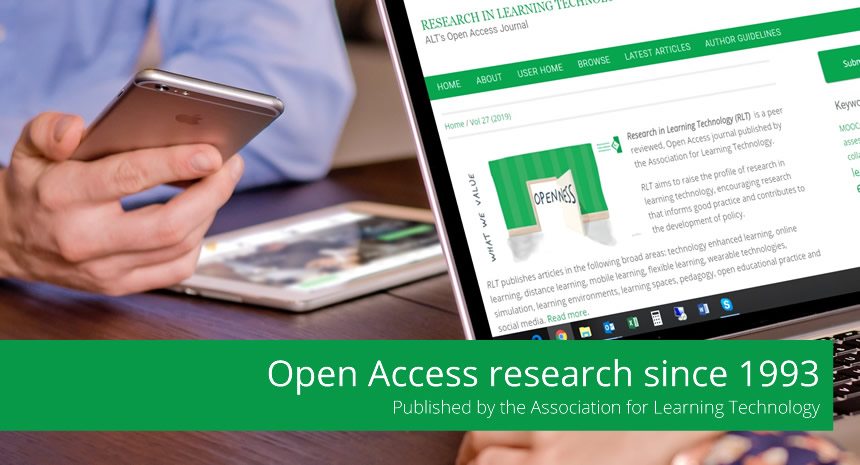
Research in Learning Technology is the journal of the Association for Learning Technology (ALT). It aims to raise the profile of research in learning technology, encouraging research that informs good practice and contributes to the development of policy. The journal publishes papers concerning the use of technology in learning and teaching in all sectors of education, as well as in industry.
The audience for Research in Learning Technology is international.
Learning technology is the broad range of communication, information and related technologies that can be used to support learning, teaching, and assessment. Founded in 1993, ALT is the UK's leading membership organisation in the learning technology field. ALT's aims are improving practice, promoting research, and influencing policy. Research in Learning Technology exists to support these aims. Potential subjects for submission include:
- evaluative studies of technology use in learning and teaching;
- studies of the impact of technologies on the efficiency and effectiveness of provision;
- studies of innovations in the area of learning technology, and their dissemination and uptake;
- critical assessment of the theory and practice of technology-enhanced learning across cultures and nationalities;
- analysis of the staff and learner competencies, roles and skills necessary for effective learning;
- theoretical debate on and analysis of the relationships between learning, teaching and technology;
- analyses of policy and strategy at institutional, regional, sectoral, national and international levels.
Research in Learning Technology is published in print four times per year. Approximately one issue per year is a guest-edited topic-based special issue for which a separate, focused call for papers is issued. Suggestions for themed special issues and guest editors are welcome and should be addressed to the editors.
Types of articles
ALT is committed to the establishment of learning technology as a discipline in its own right. Any submission whose quality and distinctiveness support this ambition will be considered. Papers should be original, scholarly and make clear how they make a contribution to the knowledge and/or practice of the field.
We are open to a range of submission types, including:
- development and testing of one or more particular learning technologies
- case studies of innovative practice
- critiques of policy or research
- surveys
- large-scale or longitudinal studies
- empirical experiments
- critical reviews of the literature
Section Policies
Editorials
Review Articles
Original Research Articles
Letters to the Editor
Book Reviews
Peer Review Process
Papers submitted to Research in Learning Technology are subject to peer review to maintain the standards of the journal, promote rigorous research within the field of learning technology, and to offer authors constructive feedback on their submissions.
Manuscripts are sent out for review electronically, and all correspondence takes place via e-mail. Although the peer review process is accelerated by the use of electronic communication, traditional, high-quality peer-review standards are applied to all manuscripts submitted to the journal.
Research in Learning Technology has a 'double blind' review process: Authors are not told who reviewed their paper, and referees do not know the name of the authors whose papers they review. The peer referees’ identity remains unknown to the authors.
Peer reviewers are asked to give their opinion on a number of issues pertinent to the quality and suitability of a paper, and to judge papers on grounds of originality and importance. We pride ourselves on providing constructive and formative feedback to authors.
Reviewer Guidelines Reviewers of Research in Learning Technology are asked to consider the following points during their evaluation:
- Does the paper have clear aims and objectives / research questions that can be achieved within the scope of a Research in Learning Technology journal paper?
- Does the paper make a contribution to knowledge?
- Is the work suitably grounded in the literature to justify its contribution and frame the analysis/evaluation?
- Is the research/evaluation methodology justified, clear and appropriate? (including ethical considerations / approval where appropriate)
- Does the analysis/ evaluation have a clear flow and logical argument?
- Does the analysis/evaluation link to an appropriate discussion and conclusions?
- Is it presented in a way which is suitable for Research in Learning Technology’s international audience?
Peer reviewers will have five possible options, for any paper:
1. Accept manuscript (i.e. no need for any revision)
2. Accept after revision (i.e. accepted if the author makes the requested revisions)
3. Revise and resubmit (i.e. accepted or rejected after revisions have been made - paper will be sent out for another peer review round)
4. Reject manuscript (i.e. if the manuscript is not sufficiently developed for publication)
5. See comments (i.e. if the reviewer cannot choose from any of the above)
In addition, papers may be returned to authors by the Editors prior to review, if judged to be out of scope, out of the limits of the word length guidance or not sufficiently prepared for publication.
To facilitate rapid publication, authors are given a maximum of 6 weeks for revision. After 6 weeks, revised manuscripts will normally be considered new submissions.
Peer reviewers are asked to give their opinion on a number of issues pertinent to the quality and suitability of a paper, and to judge papers on grounds of originality and importance. We pride ourselves on providing constructive and formative feedback to authors.
Peer reviewers will have five possible options, for any paper:
Publication Frequency
All articles to Research in Learning Technology are posted online immediately as they are ready for publication. All articles will be assigned a DOI number (Digital Object Identifier) whereby they become searchable and citeable without delay. Articles will also be collated into issues which are printed quarterly.
Open Access Policy
Open access
Research in Learning Technology - Print ISSN 2156-7069; Online ISSN: 2156-7077 - is an Open Access Journal. Author(s), their employer(s), or their funder(s) retain copyright, but license ALT to publish their work under a Creative Commons Attribution 3.0 Unported (CC BY 3.0) Licence.
Articles will be published online immediately after the final corrections of the master proof have been made, and in print grouped in an Issue. Articles are assigned a DOI number (Digital Object Identifier) for citation and other purposes.
Publication fee
Currently publishing in Research in Learning Technology is free of charge. In other words, there are no article submission or article processing fees.
Archiving
Research in Learning Technology is part of the LOCKSS system to create a distributed archiving system among participating libraries and permits those libraries to create permanent archives of the journal for purposes of preservation and restoration.
In addition, all papers published in Research in Learning Technology are archived for posterity with CLOCKSS and Portico.
A printed copy of each issue of Research in Learning Technology is lodged systematically with the UK Copyright Libraries.
Author Self-Archiving
Authors are permitted and encouraged to post items submitted to this journal on personal or institutional websites, prior to and after publication (while providing the bibliographic details of that publication).
Indexing
Research in Learning Technology is currently indexed in:
Australian Education Index (AEI); Australian Research Council (ARC) Ranked Journal List; British Education Index; Contents Pages in Education; Educational Research Abstracts Online (ERA); ERIC; ERIH (European Reference Index for the Humanities, Pedagogical and Educational Research); National Database for Research into International Education (NDRI) and PsycINFO.
Material in Research in Learning Technology is also further distributed by EBSCO, one of the world's largest content aggregators and research database providers, which helps link the content in the Journal into the research literature.
Commercial Reprints and Advertising
If you wish to purchase reprints or advertise in Research in Learning Technology, you are welcome to contact:
Caroline Sutton, Sales-and Marketing Director
Email: caroline.sutton@co-action.net
Tel (SkypeIn): +46 18 495 11 26
Tel (cell): +47 90 69 05 06
This journal is published under the terms of the Creative Commons Attribution 3.0 Unported (CC BY 3.0) Licence.
Responsible editors: Rhona Sharpe and Frances Bell.